Skip to content

Projects

AI projects across enterprise search, legal and document workflows, business data, real estate, and biomedical image analysis.

Conceptual illustration of documents, a navy magnifying glass, and organised folders.
Conceptual illustration

Enterprise Procurement Assistant

An AI assistant for searching contracts and procurement documents.

Project details: Enterprise Procurement Assistant
Problem
Relevant procurement information is spread across contracts, business documents, and structured databases.
Implementation
A multi-agent platform that searches documents and queries a structured database. Every answer cites its exact source — a document, passage, or database record — with evaluations, monitoring, and guardrails around model output.
What it does
Find relevant information and get answers across large volumes of contracts, with a source to check behind each answer.

Conceptual illustration of an organised case folder and draft documents with navy tabs.
Conceptual illustration

AI Legal Defence Builder

An AI-assisted workflow that prepares structured defence drafts for EU261 airline passenger claims.

Project details: AI Legal Defence Builder
Problem
Defence preparation for airline passenger claims involves repeated work with case information and supporting documents.
Implementation
A Python backend organizes case information and supporting documents and uses AI to prepare each defence draft in a consistent structure.
What it does
Legal reviewers receive a structured defence draft for each claim to review.
Sculpted ivory cell clusters beside matching segmentation silhouettes on a navy panel.
Conceptual illustration

THP1 Cell Segmentation for Drug-Response Analysis

Research

Deep-learning segmentation of THP1 white blood cells to measure how they respond to drug treatment.

Project details: THP1 Cell Segmentation for Drug-Response Analysis
Problem
Quantifying cell confluency and proliferation across treatment conditions means measuring cell coverage consistently across many microscopy images.
Implementation
A new 116-image THP1 dataset across six conditions (controls and PAR30 at 5–500 µg), with 62 images annotated together with a physician-researcher. A U-Net model in TensorFlow/Keras was trained, then pruned and quantized from 355 MB to 35 MB for edge deployment.
What it does
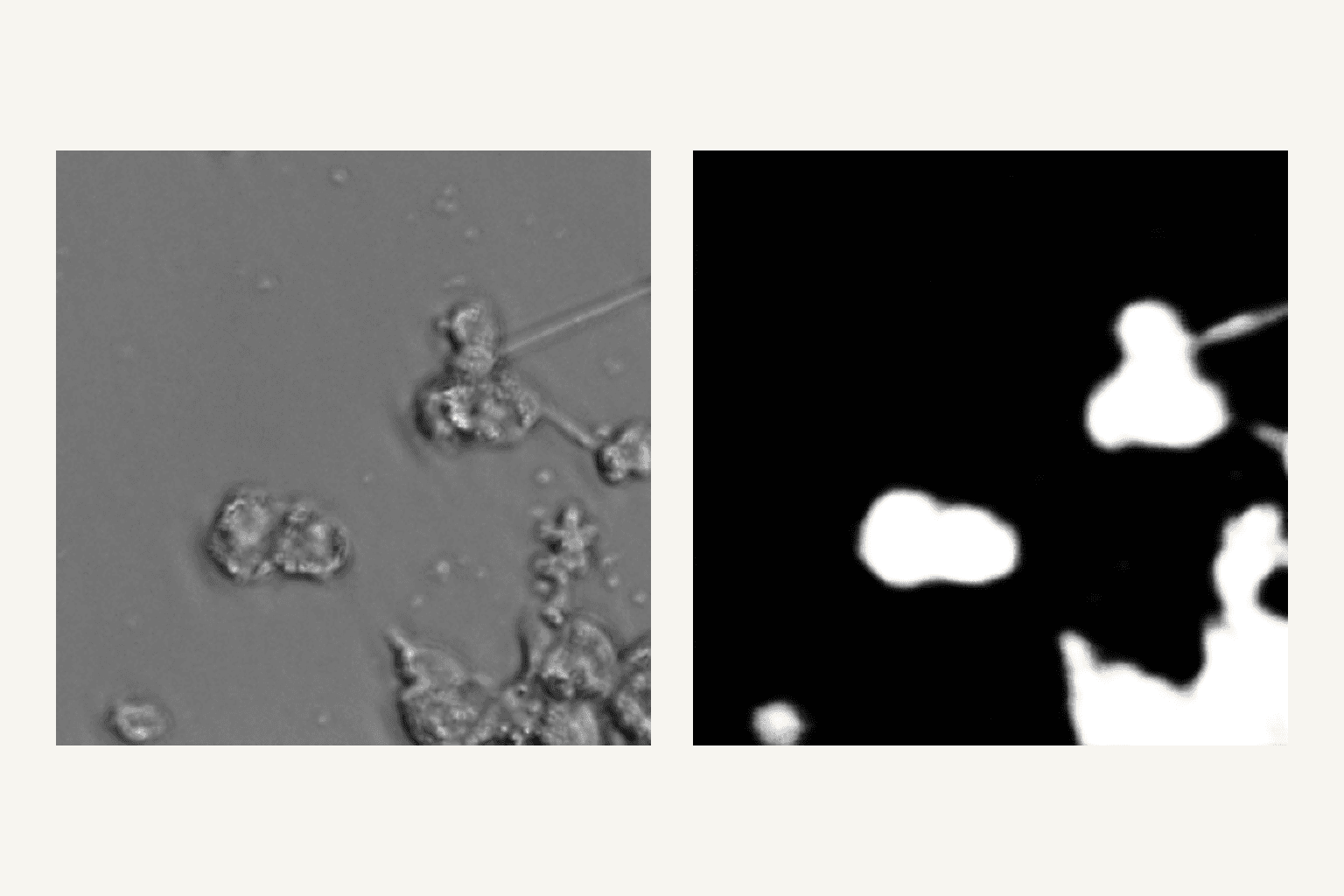
An automated pipeline segments each image, computes confluency and cell area, and aggregates results by condition. ANOVA and correlation analysis showed a clear, dose-dependent drop in cell viability under treatment.
Status
Completed in 2024 at Epoka University. Segmentation scores: Dice 0.84, IoU 0.73, precision 0.93, recall 0.93.
A microscopy image of THP1 cells beside the U-Net model's predicted segmentation mask, with cells shown in white.
Thesis result: microscopy image and predicted mask
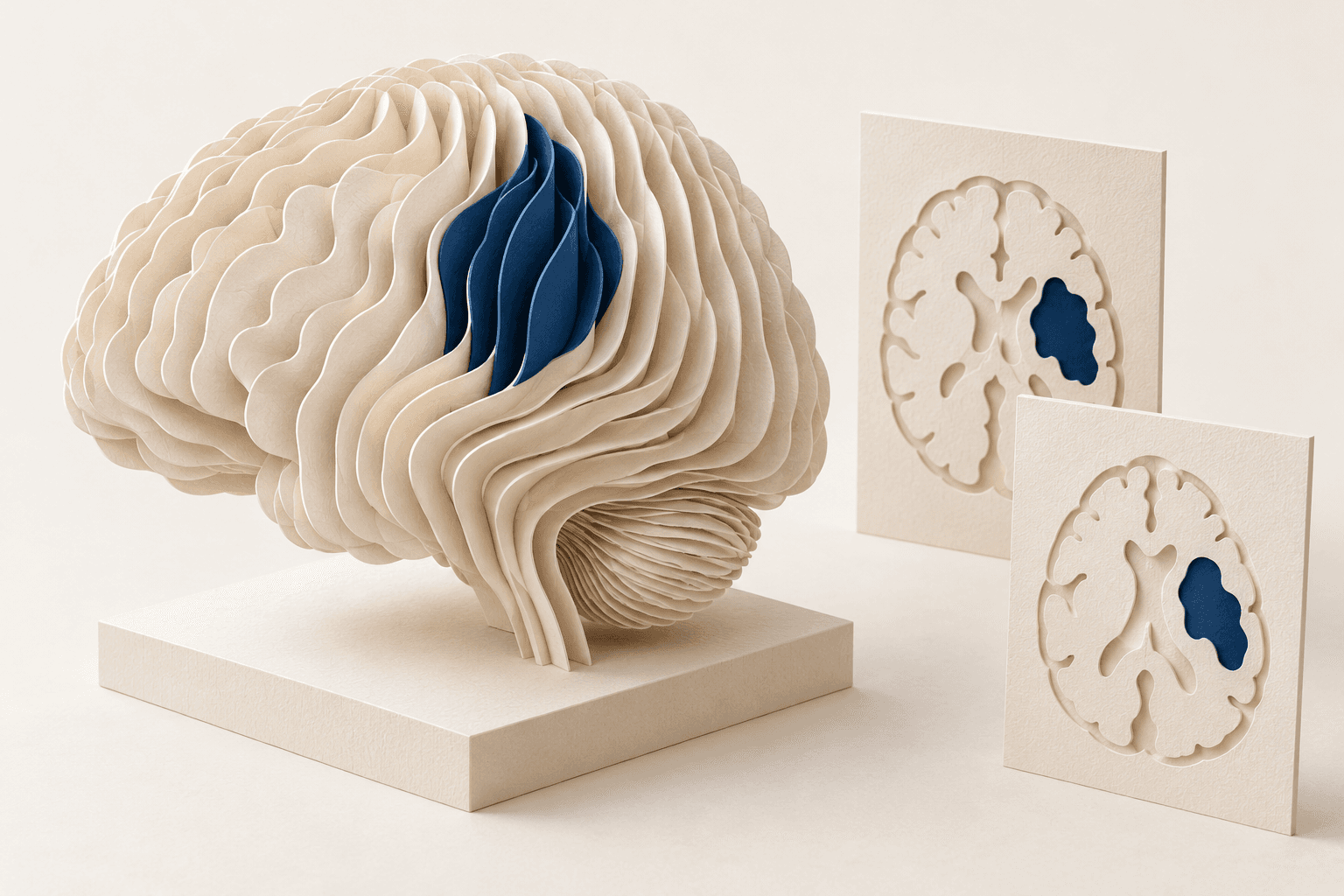
Layered ivory brain sculpture with navy highlighted regions and cross-section panels.
Conceptual illustration

3D Brain Tumour Segmentation from MRI

Research project

A 3D U-Net that segments brain tumours and their sub-regions in multi-modal MRI scans.

Project details: 3D Brain Tumour Segmentation from MRI
Problem
Outlining a brain tumour and its sub-regions means working through the full 3D MRI volume across several scan types.
Implementation
Built on the public BraTS 2020 dataset: FLAIR, T1ce, and T2 scans were normalised, cropped to 128×128×128 volumes, and stacked as channels. A 3D U-Net in TensorFlow/Keras separates background from three tumour classes, trained with a class-weighted Dice loss plus focal loss to offset class imbalance.
What it does
Produces a 3D segmentation that can be reviewed slice by slice or as an animated GIF, measures tumour volume in cm³ from the voxel spacing, and describes tumour shape through surface area, sphericity, and eccentricity.
Status
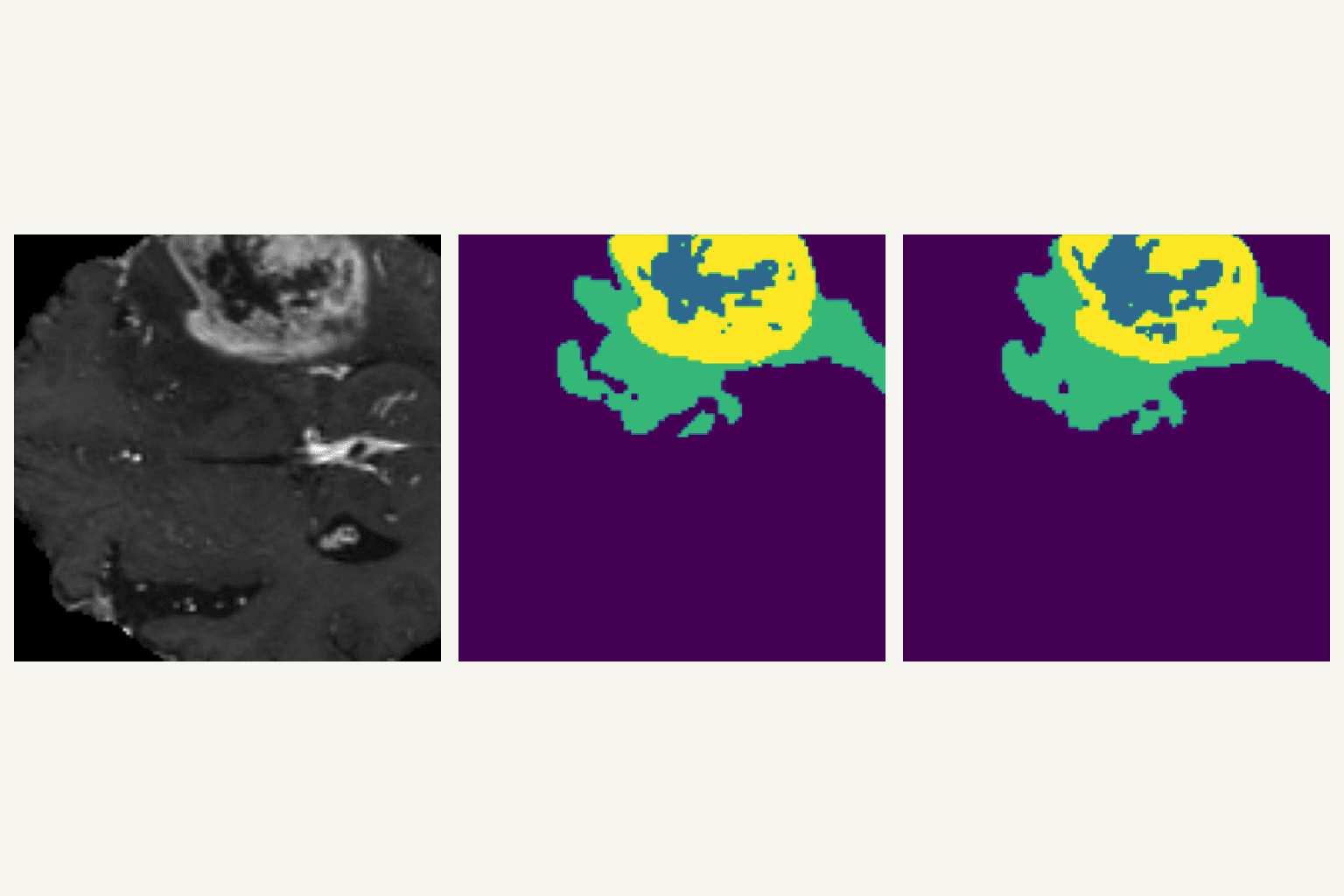
Research project, 2024. Best validation IoU of about 0.67 across 100 training epochs.
An axial brain MRI slice from the BraTS 2020 dataset beside its ground-truth tumour label and the 3D U-Net's predicted segmentation, with tumour sub-regions in different colours.
Example slice: MRI, ground-truth label, and model prediction
Conceptual illustration of paper reports with navy bar, pie, and area charts.
Conceptual illustration

Business Data Assistant

In development

Ask questions about business databases in plain English and get answers, reports, and charts.

Project details: Business Data Assistant
Problem
Business teams need a simpler way to ask questions about their databases.
Approach
The platform is designed to use table descriptions, relationships, and business context to interpret plain-English questions.
Intended use
Ask questions in plain English to retrieve and analyse data, then turn the results into reports and charts.
  • “What was our revenue last month?”
  • “Which products generated the most sales?”
Status
Ongoing prototype. The capabilities described are not yet complete.
Conceptual illustration of two paper conversation bubbles and training documents.
Conceptual illustration

AI Sales Training Assistant

In development

A conversational system for practising customer discussions and handling objections.

Project details: AI Sales Training Assistant
Problem
Sales representatives need a way to practise questions and objections in customer conversations.
Approach
A retrieval component brings together product information, customer-persona context, and training material to ground each practice conversation. Avatar and voice interaction are separate components of the broader system.
Intended use
Practise conversations with virtual customers who ask questions and raise objections. The system is being developed to support different customer personalities and levels of interest.
Status
Under active development. The capabilities described are not yet complete.
Ivory property models with navy analytics reports and an envelope.
Conceptual illustration

Real Estate Portfolio AI

An AI analytics platform that answers plain-language questions about property portfolios and sends scheduled reports.

Project details: Real Estate Portfolio AI
Problem
Property managers need answers from live property-management data — rent, delinquency, occupancy, and work orders — without writing SQL.
Implementation
A LangGraph agent classifies each question, finds the relevant tables through semantic search and LLM re-ranking, and plans the query using business rules and verified example queries. It then writes, validates, and runs read-only SQL, retrying when validation fails. Scheduled pipelines turn SQL into Excel reports and email them, and each client's data is isolated at the database level.
What it does
Ask portfolio questions and see the answer stream in, follow KPIs such as NOI against budget, delinquency, occupancy, and work orders on live dashboards, and receive automated alerts and Excel reports by email.
  • “What are the top 5 properties by rent?”
Status
Deployed for property-management clients, with automated reports running on a daily schedule.